
Income Tax Notice for Crypto in India 2026 - How to Respond
The Indian Income Tax Department has been issuing notices to crypto traders who failed to declare VDA income. This guide explains the types of notices, how exchanges share data with ITD, what to do if you receive one, and how to avoid notices in future.

Why the Income Tax Department Is Targeting Crypto Traders
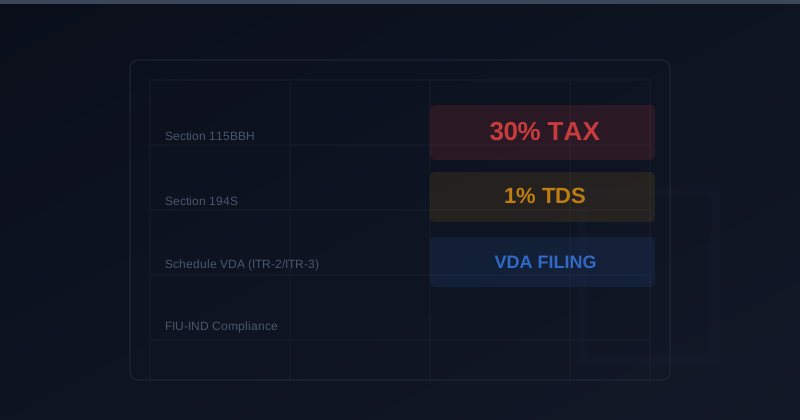
The Income Tax Department has significantly increased its scrutiny of cryptocurrency transactions since the introduction of the VDA tax framework in 2022. The combination of mandatory TDS deduction by exchanges, Annual Information Statement reporting, and data sharing agreements with financial institutions means the ITD now has access to detailed transaction-level data for Indian crypto users who traded on regulated platforms. If you traded on a FIU-registered Indian exchange and did not declare your crypto income in your ITR, there is a substantial chance the ITD already has a record of your transactions.
From 2023 onwards, the ITD has been systematically processing this data and issuing notices to taxpayers where declared income does not match the transaction data available to the department. In 2026, this process has matured, and crypto-specific notices have become significantly more common. Receiving such a notice is not the end of the world, but how you respond matters enormously for the outcome.
How Exchanges Share Your Data with the Income Tax Department
Indian crypto exchanges registered with FIU-IND are required to report transaction data to financial intelligence authorities. This data flows into the ITD through multiple channels.
- Annual Information Statement (AIS): The AIS, accessible on the income tax portal, now includes Virtual Digital Asset transactions for many taxpayers. If you traded on a regulated Indian exchange, your buy and sell transactions may appear here.
- Form 26AS: TDS deducted by exchanges on your crypto sales appears in your Form 26AS. If the ITD sees TDS credited under Section 194S in your Form 26AS but no corresponding VDA income declared in your ITR, this creates an automatic mismatch flag.
- Financial Intelligence Unit reporting: FIU-registered exchanges file Suspicious Transaction Reports and Currency Transaction Reports that can result in further scrutiny for accounts with large or unusual transaction patterns.
- Foreign exchange data: If you used international exchanges, your foreign remittances for funding those accounts may have been reported through banking channels and linked to your PAN.
Types of Notices You May Receive for Crypto
Understanding which type of notice you have received tells you both the severity of the situation and the appropriate response. The most common notice types in the crypto context are:
- Section 142(1) Notice: This is a request for information or documents. The ITD is asking you to explain or provide documentation for specific transactions or income items. This is the least severe type and usually requires you to submit your transaction history and calculation of gains.
- Section 139(9) Defective Return Notice: This notice tells you that your filed ITR has a defect, most commonly that you declared VDA income in the wrong schedule or with incomplete information. You are asked to file a revised return correcting the defect within a specified period.
- Section 148 Notice: This is a reassessment notice issued when the ITD believes income has escaped assessment. This is more serious and requires you to file a return or respond within the time specified. It typically means the ITD has concrete information about transactions you did not declare.
- Section 131 Notice: A summons for producing accounts, books, or other documents. Relatively rare for typical retail crypto traders but possible for high-value cases.
What to Do If You Receive a Crypto Tax Notice
Acting promptly and methodically is essential. Do not ignore a notice. Ignoring it will not make it go away and typically results in much worse outcomes including higher penalties and potential prosecution for wilful tax evasion.
- Read the notice carefully: Note the section number, the assessment year it relates to, the deadline for response, and the specific information requested. Keep a copy of the notice and envelope with the date received.
- Gather your complete transaction history: Download your complete trade history from every exchange you used during the relevant assessment year. This includes Indian exchanges (CoinDCX, ZebPay, etc.) and any international platforms. Include deposits, withdrawals, trades, and any staking or DeFi income.
- Calculate your gains correctly: Use crypto tax software (Koinly, Binocs, ClearTax) or engage a CA to compute your gains for the relevant year. The calculation must use the correct cost basis for each asset.
- File a revised return if needed: If you failed to declare VDA income in the original return, filing a revised return before the ITD processes your case is significantly better than waiting for an assessment order. A revised return demonstrates willingness to comply and typically results in lower penalties.
- Engage a CA: For any notice beyond a simple defective return, engage a Chartered Accountant who has experience with crypto tax matters. The nuances of VDA taxation and the specific requirements of ITD notices in this area require specialist knowledge.
Penalties for Not Declaring Crypto Income
The penalties for non-disclosure of VDA income in India are significant and can far exceed the original tax that would have been payable. Under Section 270A, the penalty for under-reporting income is 50 percent of the additional tax payable. For misreporting (which includes deliberate concealment), the penalty rises to 200 percent of the additional tax. In cases of wilful tax evasion, criminal prosecution is also possible under Section 276C.
The interest liability under Sections 234A, 234B, and 234C for late filing and late payment of tax further adds to the financial cost of non-compliance. It is always cheaper to pay your taxes correctly and on time than to face penalties and interest after a notice.
How to Avoid Crypto Tax Notices Going Forward
The most reliable way to avoid future notices is straightforward but requires discipline from the start of each financial year.
- Declare all VDA income in Schedule VDA of your ITR-2 or ITR-3 for every financial year in which you had any crypto transaction, including years where you made a loss.
- Ensure your AIS and Form 26AS match your ITR declarations before filing. Review your AIS on the income tax portal and reconcile any VDA transactions shown there with what you plan to declare.
- Use crypto tax software that generates an ITD-compatible report rather than manually calculating your crypto P&L, which is error-prone across many transactions.
- Do not use crypto as a way to store undisclosed income. The transparency that the VDA framework creates around exchange transactions makes this approach increasingly detectable and the consequences increasingly severe.
Receiving an income tax notice for crypto is stressful, but it is manageable with prompt, honest, and well-documented responses. The ITD's primary goal is tax recovery, not punishment. Demonstrating full cooperation and correct calculation of your liability is the most effective approach to resolving any crypto tax notice.
Track Your Crypto Portfolio with AI Insights
SmartViewAI gives Indian investors live portfolio analytics, AI health scores, and trading signals. Connect your exchange account and see your full portfolio picture in minutes.